
This is a subtitle for your new post

Top Growth Marketing Agency — Practical Strategies to Drive Traffic, Leads, and Sales
Growth-focused digital marketing blends SEO, paid media, web design, social, and strategy to bring qualified visitors, convert them into leads, and scale revenue predictably. This guide explains which services move the needle, how growth teams build repeatable systems, and which KPIs actually show progress. You’ll learn when to favor short-term channels like PPC versus long-term plays like SEO, how fast testing speeds wins across local and national markets, and a measurement framework to attribute value to marketing spend. Ready to act? Schedule a free strategy session with Pride Born Ventures and we’ll turn these tactics into a KPI-driven roadmap built for your goals. The sections below map services, ideal industry fits, web and social tactics, and the metrics that turn activity into reliable growth.
Which Digital Marketing Services Actually Drive Business Growth?
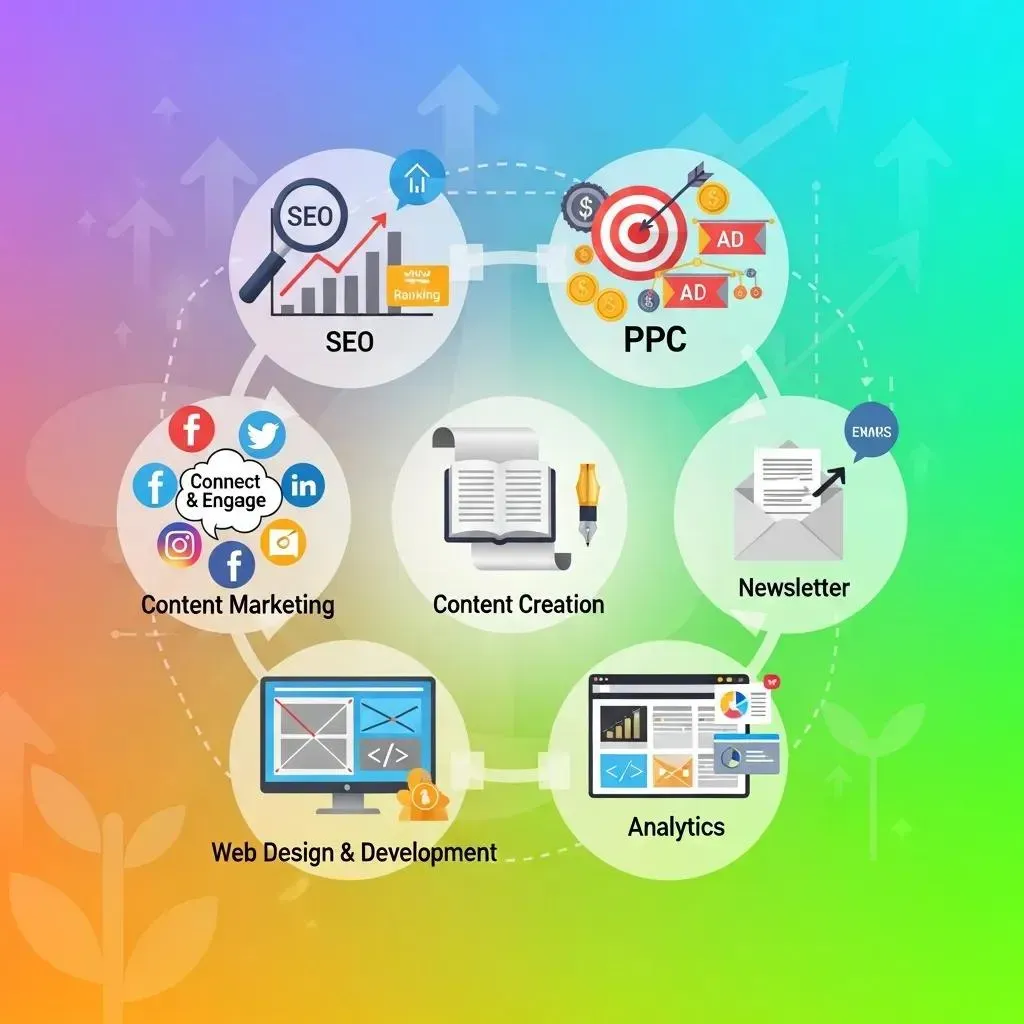
Services that consistently drive growth combine clear discovery, precise targeting, disciplined execution, and tight measurement to move prospects through the funnel. Each core category answers a timing or funnel need: SEO builds long-term organic visibility, PPC creates immediate demand, custom web design improves conversion paths, social builds audiences and remarketing pools, and consulting ties channels back to ROI. Below is a compact list of core services and why they matter—written for fast decisions.
The most effective services for growth include:
- SEO services: increase organic visibility and generate steady, qualified inbound leads over time.
- PPC campaign management: produces immediate, measurable leads while controlling acquisition cost.
- Custom web design & development: simplifies the user journey and raises conversion rates to maximize traffic value.
- Facebook Ads & social media marketing: builds audiences, retargets engaged users, and strengthens brand credibility.
- Marketing consulting & strategy: aligns channels and budgets to revenue targets and measurable KPIs.
These services work best as a coordinated, full-funnel approach: paid channels kickstart demand while SEO and content compound to lower long-term acquisition costs. Knowing how each piece complements the others clarifies budget allocation and scaling priorities at every growth stage.
The table below compares timelines, KPIs, ideal use-cases, and typical ROI windows for each core category.
| Service | Typical Time-to-Impact | Primary KPIs | Ideal Use-Case |
|---|---|---|---|
| SEO Services | 3–9 months | Organic traffic, keyword rankings, leads | Brand visibility, content-led growth |
| PPC Campaigns | Days–Weeks | CPC, conversion rate, CPA, ROAS | Fast lead generation, promotions |
| Custom Web Design & Dev | Weeks–Months | Conversion rate, bounce rate, page speed | CRO-focused traffic monetization |
| Paid Social & Community | Weeks | Impressions, engagement, cost-per-lead | Brand building, remarketing audiences |
| Marketing Consulting & Strategy | Days–Weeks | CAC, LTV projections, channel mix | Strategic alignment, budget planning |
This comparison helps decision-makers match channel choice to short- and long-term objectives. Next, we dive into how SEO drives organic growth.
How Do SEO Services Boost Organic Traffic and Lead Generation?
SEO grows organic traffic by fixing the technical foundation, improving on-page relevance, and building off-page authority so search engines surface your pages to people actively searching for solutions. Technical fixes—crawlability, site speed, mobile experience, and structured data—make your site indexable and fast. On-page SEO aligns content and metadata with user intent to capture qualified clicks, while off-page work (links and citations) builds the authority that improves rankings. Paired with conversion-optimized landing pages, these efforts increase scalable lead volume.
SEO follows a discovery → prioritization → execution → optimization loop that delivers early content wins and then scales to broader keyword sets. That loop pairs naturally with conversion rate optimization to turn traffic into leads.
Why Are PPC Campaigns Essential for Immediate ROI and Qualified Leads?
PPC generates demand by placing targeted ads in front of users with high purchase intent, delivering immediate, trackable lead flow while longer-term channels ramp. Effective PPC mixes keyword intent, audience segmentation, creative testing, and landing-page alignment to lower acquisition costs and boost conversions. Search, remarketing, and display each serve distinct roles: search captures active demand, remarketing re-engages warm prospects, and display builds top-of-funnel awareness. KPIs such as CPC, CPA, conversion rate, and ROAS let teams optimize budgets quickly and tie performance to revenue.
Because it’s immediate and data-driven, PPC is the go-to when time-to-lead matters—and the insights from PPC (creative and landing-page tests) often inform SEO and organic strategy.
PPC and paid search remain central to modern digital programs—ongoing research continues to refine measurement and optimization practices.
PPC and Paid Search: Measurement, Optimization, and ROI in Digital Marketing
This systematic literature review evaluates PPC and paid search across industry contexts and their impact on customer acquisition and short-term revenue. Based on a methodological analysis of 39 scholarly studies published between 2015 and 2025, it highlights emerging practices—machine-learning bidding, incrementality testing, and multi-touch attribution—while noting uneven adoption and gaps in longitudinal reporting. Improved measurement and attribution help advertisers make better budgeting decisions and respond to shifting market dynamics. Pay Per Click and Paid Search: Cost-Effectiveness and ROI in Digital Marketing, LA Maluleke
How Does a Growth Marketing Agency Customize Strategies for Scalable Business Success?
A growth agency builds scalable strategies by combining market research, audience segmentation, and KPI-driven planning to create repeatable systems. Work starts with discovery—audience, competitor, and funnel analysis—then sets ROI targets that determine channel mix and budget. Implementation uses agile testing: small experiments validate creative and targeting, winners scale, and underperforming tests are iterated or paused. Transparent measurement and reporting close the loop so teams reallocate spend to the highest-performing levers and forecast the impact of scaling decisions.
This process adapts to local or national differences and keeps measurement tightly tied to revenue outcomes. The next section lays out the typical workflow.
The agency workflow typically includes these prioritized steps:
- Discovery & research: map audiences, competitors, and current funnel performance.
- Strategy & target-setting: define CAC, LTV, and ROAS goals to guide channel mix.
- Implementation & testing: run controlled experiments to validate hypotheses.
- Scaling & optimization: increase investment in validated channels and iterate creatives.
- Reporting & governance: maintain transparent dashboards and regular optimization cadences.
These steps form a repeatable growth engine where each phase feeds data into the next, enabling predictable scaling across markets and products.
What Makes ROI-Driven Marketing Strategies Different?
ROI-driven marketing prioritizes measurable outcomes—CAC, LTV, ROAS—over vanity metrics, linking each tactic to revenue impact and spend efficiency. Using attribution models, teams determine how channels contribute to conversions and allocate budget where marginal return is highest. In practice, an ROI focus shapes testing cadence, bid strategies, and landing-page experiments to lower acquisition costs and increase lifetime value. With clear financial targets monitored near real-time, teams scale or stop campaigns based on profitability rather than impressions or clicks alone.
Framing strategy around ROI also requires close collaboration between marketing and sales so lead quality and downstream revenue are tracked accurately, enabling smarter scaling and tighter optimization cycles.
How Does Agile Marketing Enable Adaptation Across Local and National Markets?

Agile marketing uses quick experiments, short feedback loops, and data-driven pivots to tailor messaging and tactics by geography and audience. For local markets, that looks like geo-targeted creatives, localized landing pages, and local SEO signals; for national campaigns, it means scalable audiences, broader creative variants, and centralized measurement. Rapid A/B and multivariate tests reveal which messages work where—then teams scale winners while preserving local nuance. This iterative approach reduces risk and shortens the time from hypothesis to scalable playbook.
Agile testing turns market-specific ideas into repeatable tactics that let brands scale without losing regional relevance.
Which Online Marketing Solutions Deliver the Best Results for Different Industries?
Channel mixes must reflect buyer behavior, sales cycles, and regulations that vary by vertical. Mapping services to industry needs clarifies which tactics reliably deliver results: law firms often rely on local SEO and search ads to capture high-intent leads; real estate benefits from listing optimization and paid social for visual discovery; SaaS grows with content-driven SEO plus paid acquisition and product trials; e-commerce focuses on paid social, Google Shopping, and CRO for fast revenue. The table below maps industries to recommended services and expected outcomes to help prioritize investments.
| Industry | Recommended Services | Expected Outcomes / Metrics |
|---|---|---|
| Law Firms | Local SEO, PPC, Lead Gen | Higher-quality calls and form submissions; increased booked consultations |
| Real Estate | Local listings, Paid Social, Web UX | Improved lead-to-showing conversion; more qualified buyer/seller leads |
| SaaS | Content + SEO, Paid Acquisition, Product Trials | Increased MQLs, trial activations, reduced CAC over time |
| E-commerce | Paid Social, Search Shopping, CRO | Faster revenue growth, lower cost-per-sale, higher AOV |
| Home Services | Local SEO, Rank-and-Rent, PPC | More booked jobs, higher local visibility, improved lead quality |
This mapping sets realistic expectations and helps teams select a scalable mix that aligns with sales processes and lifetime value.
To put these mappings into action, keep three quick rules per industry in mind:
- Law firms: prioritize local SEO and paid search to capture immediate consult intent.
- SaaS: invest in content and product trials to nurture longer purchase journeys.
- E-commerce: focus on paid social creative testing and CRO to turn traffic into transactions.
These guidelines convert vertical patterns into concrete channel experiments you can test and scale.
How Does Digital Marketing for Law Firms, Real Estate, and SaaS Differ?
Marketing differs by funnel length, regulatory constraints, and buyer intent across law, real estate, and SaaS. Law firms depend on local search and trust signals because clients choose based on proximity and credibility; messages must be compliance-safe and conversion-focused. Real estate leans on visual content, local listings, and retargeting to move online interest into in-person showings. SaaS prioritizes content-led acquisition, trial conversion, and onboarding funnels to maximize adoption and lifetime value. These differences require distinct creative, channel priorities, and measurement approaches for each vertical’s buying rhythm.
Understanding these distinctions helps marketers build industry-specific playbooks that respect buyer behavior and sales cadence. The next subsection shares measurable case examples.
What Case Studies Demonstrate Measurable ROI Across Sectors?
Short case summaries show approach and outcomes: a law firm increased booked consultations by optimizing local landing pages and running a targeted PPC campaign; a SaaS company combined content-first SEO with paid acquisition to lower CAC over six months; an e-commerce brand boosted conversion rate through a site redesign plus segmented paid social that doubled ROAS. Each example follows a problem → approach → measurable result format so you can reuse the playbook for your market.
These patterns underline a repeatable process: diagnose the funnel, run experiments, and scale validated tactics to deliver measurable ROI.
Measuring ROI matters across industries—specialized guides show how to apply these principles in sector-specific contexts.
Measuring Digital Marketing ROI for Healthcare: Strategies and KPIs
This chapter explains how healthcare providers can measure and improve ROI from digital marketing. It adapts the ROI formula to healthcare settings and aligns marketing with clinical and business goals. Topics include strategic planning with SMART goals, patient preferences, and channel selection—SEO, PPC, social, email, mobile apps, and websites—plus channel-specific optimization tactics and KPI guidance. Measuring ROI in Digital Marketing for Healthcare Providers, 2025
How Can Custom Web Design and Social Media Marketing Improve Engagement and Conversions?
Custom web design and social marketing raise engagement and conversions by aligning UX with acquisition channels and brand messaging—reducing friction and reinforcing relevance at every touchpoint. An SEO-friendly structure and fast, mobile-first pages improve discoverability and lower bounce rates, increasing conversions from both organic and paid traffic. Social amplifies brand stories, builds community, and creates retargeting pools that convert at higher rates. When design, content, and paid social are coordinated, the result is higher lifetime value, stronger brand authority, and more efficient customer acquisition.
Below are UX and design best practices that directly influence conversion and engagement.
- Mobile-first design: prioritize responsive layouts and touch-first interactions for most users.
- Fast load times: improve page speed to reduce bounce and boost SEO.
- Clear CTAs and funnels: simplify decisions and remove friction to increase conversions.
- Structured data and metadata: improve search presence and click-through rates.
These practices create conversion-ready experiences that raise the return on both organic and paid investments.
What Role Does SEO-Optimized Web Design Play in Conversion Rate Improvement?
SEO-minded web design improves conversion by ensuring pages load fast, follow a clear information architecture, and serve intent-aligned content. Technical elements—page speed, mobile responsiveness, structured data—help pages rank and attract qualified visitors, while persuasive copy and streamlined forms reduce friction and improve conversions. Combining SEO and CRO compounds benefits: higher rankings bring more traffic, and a conversion-first UX captures a larger share of that traffic. Track bounce rate, time on page, and conversion rate before and after changes to measure the impact of an SEO-centered redesign.
That’s why design and SEO should be integrated early in any growth program so traffic converts efficiently across campaigns.
How Do Paid Social Campaigns and Community Management Build Brand Authority?
Paid social scales reach by targeting audiences with conversion-focused creative and retargeting warm users for action. Community management supports paid efforts by building trust, answering questions, and driving organic engagement that strengthens brand signals. Together they improve sentiment, increase retention, and create remarketing pools that convert at higher rates. Key KPIs include engagement rate, sentiment trends, audience growth, and conversion lift from social-driven traffic.
Coordinating paid creative with authentic community responses keeps messaging cohesive and persuasive, which improves conversion efficiency across the funnel.
What Key Performance Indicators Measure Digital Marketing Success for Growth?
KPIs quantify traffic, engagement, lead quality, and financial return so teams optimize toward revenue goals rather than activity. Core KPIs include organic traffic, qualified leads, conversion rate, customer acquisition cost (CAC), lifetime value (LTV), and return on ad spend (ROAS). Using consistent definitions and dashboards enables benchmarking and smarter budget shifts that improve profitability. The table below defines primary KPIs, what they measure, and common tracking methods and starter benchmarks.
| Metric | What It Measures | How to Track / Benchmark |
|---|---|---|
| Organic Traffic | Volume of search-driven sessions | GA4 + Search Console; benchmark depends on industry growth targets |
| Qualified Leads | Leads meeting sales-ready criteria | CRM + lead scoring; benchmark = conversion from MQL to SQL |
| Conversion Rate | Percentage of visitors who convert | Pages / funnels in GA4 or tag manager; aim to improve via CRO |
| CAC | Cost to acquire a customer | Total marketing spend / customers acquired; compare to LTV |
| LTV | Revenue per customer over lifetime | Cohort analysis in CRM or analytics; benchmark vs CAC for payback |
| ROAS | Revenue per ad dollar spent | Ad platform revenue attribution; target varies by business model |
This table gives teams a compact reference to standardize KPI language and align measurement across channels, supporting more reliable optimization and forecasting.
Which Metrics Track Organic Traffic, Lead Conversions, and ROI?
To track organic traffic, monitor sessions from organic search, keyword trends, and landing-page engagement in analytics and Search Console. For lead conversions, use event tracking, form submissions, and CRM-connected conversion events to measure MQLs and SQLs, then map those to revenue. ROI metrics—CAC, LTV, ROAS—require cross-system attribution that combines ad costs, CRM revenue data, and cohort analysis to calculate payback periods and profitability. Recommended tools include GA4 for web analytics, ad platforms for paid attribution, and a CRM for revenue mapping; consolidating these sources into a dashboard creates a single source of truth for decisions.
Accurate tracking helps teams follow trends over absolute numbers and prioritize experiments that move the metrics that matter to growth.
How Does Scheduling a Free Strategy Session Accelerate Business Growth?
A free strategy session accelerates growth by delivering a focused, KPI-driven audit and a prioritized roadmap of high-impact actions tailored to your business. Typical outputs include a diagnostic of current channel performance, quick-win recommendations, and a 90-day roadmap tied to CAC and LTV goals. By aligning stakeholders on measurable objectives and immediate tests, the session turns ambiguity into a short list of experiments you can run and measure. For teams evaluating agencies or seeking clarity, a structured session shortens the path to measurable results and clarifies the investment needed to hit specific growth targets.
If you want a KPI-driven audit and a prioritized plan centered on ROI, a free strategy session with Pride Born Ventures delivers immediate clarity and next steps.
Why Choose Pride Born Ventures as Your Digital Marketing Partner in Orlando and Beyond?
Pride Born Ventures is a full-service growth agency that builds scalable marketing systems to drive traffic, leads, and sales with an ROI-first approach. Our core services include custom web design & development, SEO, Google Ads & PPC campaign management, Facebook Ads & social media marketing, lead generation & rank-and-rent marketing, and marketing consulting & strategy. We emphasize transparent reporting, agile execution, deep local and national experience, and an in-house team that delivers tightly integrated strategies. Those strengths help clients who want measurable, accountable growth—not activity for its own sake. Compared to common competitor patterns, Pride Born leans harder on ROI, reporting transparency, and rapid execution to speed learning cycles and support defensible scaling decisions.
What Unique Benefits Does Pride Born Ventures Offer Compared to Competitors?
Pride Born Ventures delivers benefits tied directly to measurable outcomes: an ROI-first strategy that links budget to profitability, transparent reporting that clarifies true channel performance, agile systems that iterate quickly to find winners, an elite in-house team for integrated execution, and the ability to serve both local and national markets with tailored playbooks. Each benefit leads to faster optimization, clearer budget decisions, and a single accountable team executing end-to-end. These strengths reduce friction between strategy and delivery and help organizations scale with predictable economics.
If your priority is measurable growth backed by transparent metrics and a nimble execution team, Pride Born Ventures is set up to deliver—start with a free strategy session to diagnose high-impact opportunities.
How Does Our Free Strategy Session Help Businesses Scale Effectively?
Our free strategy session is built to produce immediate clarity: a short diagnostic of current traffic and conversion performance, identification of quick wins, and a prioritized roadmap tied to CAC and LTV targets. During the session we review target audiences, channel performance, and low-effort, high-impact tests you can run in the next 30–90 days to improve acquisition efficiency. Deliverables typically include a brief audit summary, a prioritized action list, and recommended measurement checkpoints to track progress. This practical output reduces indecision and gives an actionable path to scale—making the session a high-value first step for teams ready to accelerate measurable growth.
If you’re ready to convert strategy into action, a free strategy session will give you a prioritized, KPI-focused plan to begin scaling immediately.
Written by Justin Harper. Chief Growth Strategy Officer at Pride Born Marketing.